a quasi-review; or, how having saints secures jesus' divinity
3 Comments
»
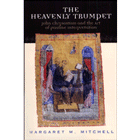
If you know nothing else of John Chrysostom, know that he was veritably in love with Paul. This isn't a weird or gross thing, though, seeing as John was wholly enveloped (despite being a prominent orthodox Christian preacher/pastor/leader/bishop) in the secular rhetorical world. Paul was able to make (fairly) plain for average Christians the import of the teachings of Christ, being himself highly rhetorical in the process. Paul was the most important Christian to Chrysostom, because even though Paul was the Saint of Saints, he was fully man, fully emulatable.
Margaret Mitchell, despite writing on a very niche subject in Church History, brings this to the fore in her book, "The Heavenly Trumpet." She addresses something very important at the outset: why doesn't Chrysostom speak so passionately about Jesus himself? Why does he focus on the man Paul to encourage his congregation/audience? It isn't because imitating Jesus is a hopeless cause; otherwise, Chrysostom's Trinitarian theology would be bankrupt. Ironically, I almost see it as a move to preserve his high regard for Jesus' divinity above anything else.
Like all theology, shooting for the via media is also preferable. We've seen countless instances of heresy in the Church's past (and present) when someone wants to take part of a balanced issue to far. I don't think John errs on the side of saint-worship in an effort to maximize Jesus' divinity here. I think, instead, he shows us lucidly why surrounding ourselves with the saints is not a bad thing.
Obviously, as Christians, we want to be "little Christs." But the reason we look to saints is because they start out with everything we start out with; they are fully human, fully capable of both going astray and staying the course with God. Despite some who seem to have dipped their hands in the utterly and almost unbelievably miraculous, saints are people we can truly imitate. I can only imitate Christ insofar as he was fully human; I can't truly imitate Christ in his fullness. I can never be begotten from the Father like he does, nor can I experience divinity through the power of the Holy Spirit (that was for Ben...for the rest of us: "I can't allow the Holy Spirit to proceed from me ;-) ). I don't have two natures somehow united yet unconfused in my self. My death will not affect anything. Worshipping me will only get you sent to the wrong place. I want my being to be as close to Christ as possible, but I'm not so concerned about turning into a Messiah.
On the other hand, I can grow in relationship to God. It is possible that I may have to preach to thousands of people one day and train them in the Faith. It is possible that one day I might have to face an untimely death at the hand of those who have a problem with my faith. I can relate more easily to people who don't have the option to call legions of angels from heaven to help me, what can I say? None of this is to say that I'm trying to distance myself from Christ, nor that I want to be more distant from Christ. In fact, I think the opposite; I'm a huge proponent of understanding Christian growth as theosis. The thing is, because of that, and not in spite of that, I find it appealing to look toward people who bridge the gap even further between myself and Christ.
I look toward saints as people who were utterly used by God, despite problems, despite obstinacy, despite physical shortcomings, despite emotional setbacks. I don't believe Christ was used by God to accomplish anything; Christ is God, for crying out loud! True, Christ "bridged the gap"; Christ experienced everything a human could experience in the fullness of his humanity. But at the end of the day, despite being made in the form of a servant, and subjecting himself to such a death as that on the cross, Christ was more than a fabulous guy; and because of this, the gap between he and I is very, very real. Since I want to bridge that gap any way I can, I look to the saints who have done so the best.

 Subscribe by RSS
